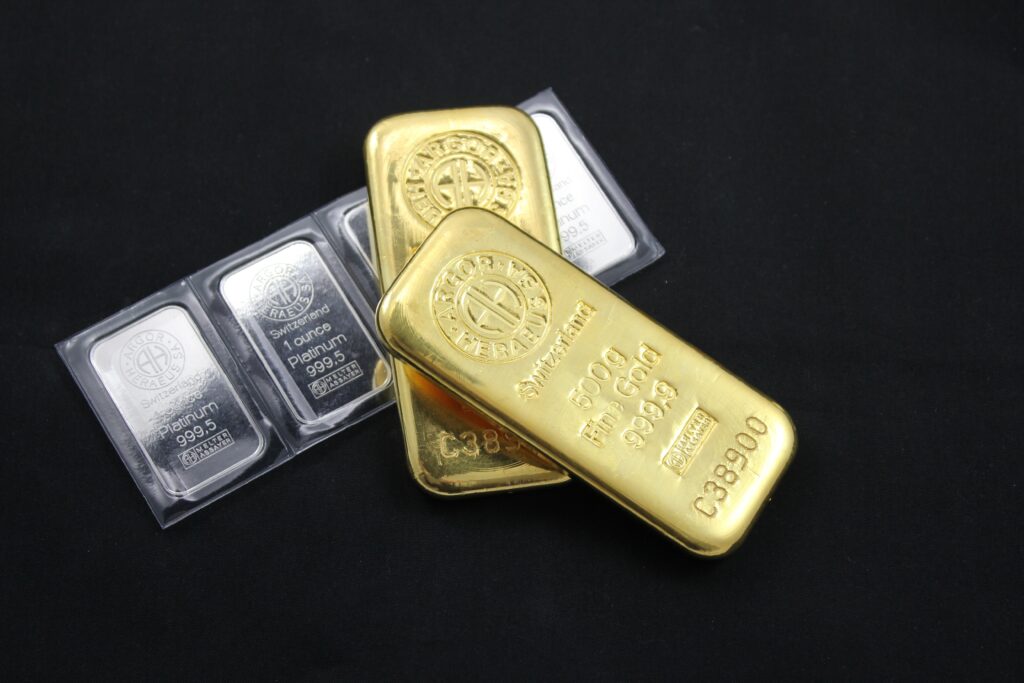
Whether you’re looking to buy gold bars or gold ETFs, if you want to buy gold safely, there are a few things to take note of.
Gold has arguably been one of the world’s preferred investment products from the dawn of civilization to the present day. You might have heard of the term ‘safe haven asset’. If you have, you might know that this precious metal is now mostly purchased as a hedge against political turmoil and inflation.
Additionally, many top investment consultants recommend allocating a portion of your portfolio to gold to reduce risk.
When things are rough in the economy or international conflicts like the one between Russia and Ukraine throw the markets for a loop, investors typically turn to gold.
With inflation on the rise and the stock market trading at a low, some investors are turning to gold given its established track record of returns.
Gold is popular among investors for a variety of reasons, and it has characteristics that make it an excellent complement to typical investments like equities and bonds.
Professional fund managers regard gold as a store of value, even though it is a cash-neutral asset. Some regard gold as a hedge against inflation, citing the Federal Reserve’s measures to stimulate the economy, such as near-zero interest rates and increased government spending, as reasons to do so.
That being said, gold is not for everyone, and some investors choose to put their money into cash-flowing businesses rather than relying on someone else to pay more for the precious metal. This is the reason why great investors like Warren Buffett advise against investing in gold and instead recommend buying cash-flowing businesses. Stocks and mutual funds are also straightforward to own and very liquid, allowing you to rapidly convert your investment to cash if necessary.
Despite it being considered a safe have asset, like any investment, buying gold can be risky. Here’s a guide on how to buy gold and silver safely.
4 Of The Safest Ways To Buy Gold
1. Getting Your Hands On Physical Gold Such As Gold Bars

Buying gold in bars or coins is one of the more emotionally fulfilling methods of owning this precious metal. You’ll get pleasure from looking at and touching it, but if you possess more than a little portion, ownership comes with major costs. One of the most significant disadvantages is the requirement to safeguard and insure actual gold.
Physical gold buyers are completely reliant on the commodity’s price increasing to make a profit. In contrast, owners of a business (such as a gold mining company) might create more gold and hence make more money, increasing the value of their investment in that business.
If you want to buy gold locally, you can buy gold bullion from a variety of sources, including an online vendor like APMEX or JM Bullion, or a local dealer or collector. A pawn shop may sell gold as well.
When buying gold, keep track of the spot price – the price per ounce on the market right now – so you can get a good deal. You may choose to buy gold bars rather than coins because you’ll likely spend more for the collector value of a coin than the gold content. (These aren’t all made of gold, but they are among the most valuable coins in the world.)
The biggest risk is that someone could physically grab your gold if you don’t keep your assets secure.
If you need to sell your gold, you face the second-largest risk. It can be difficult to get the full market value for your assets, especially if they are coins and you require cash immediately. As a result, you may have to sell your shares for considerably less than they would sell for on a national market.
2. Gold Mining Stocks
Another option to profit from rising gold prices is to invest in the mining companies that produce it.
This option is very beneficial for investors because they can earn from gold in two ways. First, when the price of gold rises, so do the miner’s profits. Second, the miner might gradually increase production, creating a double whammy effect.
The risk is when investing in particular equities, you must thoroughly understand the business. Mining operations can be hazardous, so choose one that has an established track record.
Small miners and those without a producing mine should probably be avoided. Finally, mining equities, like other stocks, can be quite volatile.
3. Gold ETFs
Don’t have time to research specific gold companies? Then investing in an ETF might be a good idea.
Gold miner ETFs will give you exposure to the market’s largest gold miners. You won’t be impacted as much by the underperformance of a single miner because these funds are dispersed across the industry.
VanEck Vectors Gold Miners ETF (GDX), VanEck Vectors Junior Gold Miners ETF (GDXJ), and iShares MSCI Global Gold Miners ETF (RING) are some of the largest funds in this category. As of March 2022, the cost ratios for the funds were 0.51%, 0.52%, and 0.39%, respectively. These funds combine the benefits of particular mining companies with the security of diversification.
The risks are that while the diversified ETF protects you from one bad firm, it won’t protect you from something that impacts the entire sector, such as low gold prices for an extended period.
Also, when choosing a fund, keep in mind that not all funds are made equal. Some funds have more established miners, while others have riskier junior miners.
4. Gold Futures and Options
Futures are contracts to buy or sell a specific amount of an object, in this case, gold, on a future date.
Futures represent a predetermined amount of gold and are exchanged in contracts rather than shares. Futures are ideal for experienced investors because this quantity can be big (for example, 100 troy ounces x $1,000/ounce = $100,000).
Futures are popular because they have inexpensive charges and low margin requirements compared to regular equities transactions. As some contracts settle in dollars and others in gold, investors must read the contract details carefully to avoid having to take delivery of 100 ounces of gold on the settlement day.
Futures options are a viable alternative to purchasing a futures contract outright. These provide the option owner with the right to buy the futures contract at a certain price within a specified time frame.
An option has the advantage of leveraging your initial investment while also limiting losses to the price paid. If losses increase quickly, a futures contract purchased on leverage may require more capital than was originally deposited.
Unlike a futures investment, which is based on the current price of gold, the disadvantage of an option is that it requires the investor to pay a premium over the underlying price of gold to hold it.
Futures and options may be unsuitable for many investors due to their high volatility.
.
This is an article sample. Want an article like this done for you? Click here and make a booking using the booking form.