
Digital marketing funnels are integral components to optimizing sales and conversions through online measures, used by countless successful brands and businesses to guide prospects throughout the opt-in journey. Different structures exist for various objectives and preferences, but the end goal generally remains the same – to channel sales into your running business.
Social media marketing plans, advertising strategies, and content marketing tactics are widely used by many current brands online, and they are associated with the structure of digital marketing funnels. Today, it’s likely that almost every organization uses digital marketing tools to its benefit. Digital marketing has a universal appeal, from big companies to small startups. There is, however, a catch. Not all digital marketing funnels, instruments and techniques work equally. Their effectiveness largely depends on the organization, the target audience, and the goals of the business. So, for a big company, what could perform incredibly well might not yield the same results for a startup.
It doesn’t have to cost a great deal of money to build a killer digital marketing campaign. Your time, commitment and imagination are all that is needed. You can brainstorm your way to building solid digital marketing funnels and these days numerous powerful tools are accessible to all and at your disposal for business excellence.
There are plenty of marketing resources that are simple, affordable and effective, but this doesn’t necessarily mean it’s a walk in the park. The barrier to entry for effective digital marketing is lower than ever, meaning you and your competition are battling toe-to-toe with similar capacities for growth. This competitive environment will persist well beyond 2021, and it’s important that you know how to develop a great marketing funnel before moving on to the advanced steps. So, let’s start with the basics.
What a digital marketing funnel is (and isn’t)
A common misconception is that digital marketing funnels and the buyer’s journey are the same thing, but you’d be missing out on a lot of what the marketing funnel can do for you. Despite their similarities, having both these tools in ones marketing arsenal is essential.
The buyer’s journey can be described as a flow chart of sorts, depicting the mental process that your customers go through before deciding to buy anything from you. It’s what you use to get to know your customer and create a well-informed marketing funnel.
On the other hand, the marketing methods you use to handle each stage of the buyer’s journey are referred to as a marketing funnel. They’re both vital, but they’re not the same thing.
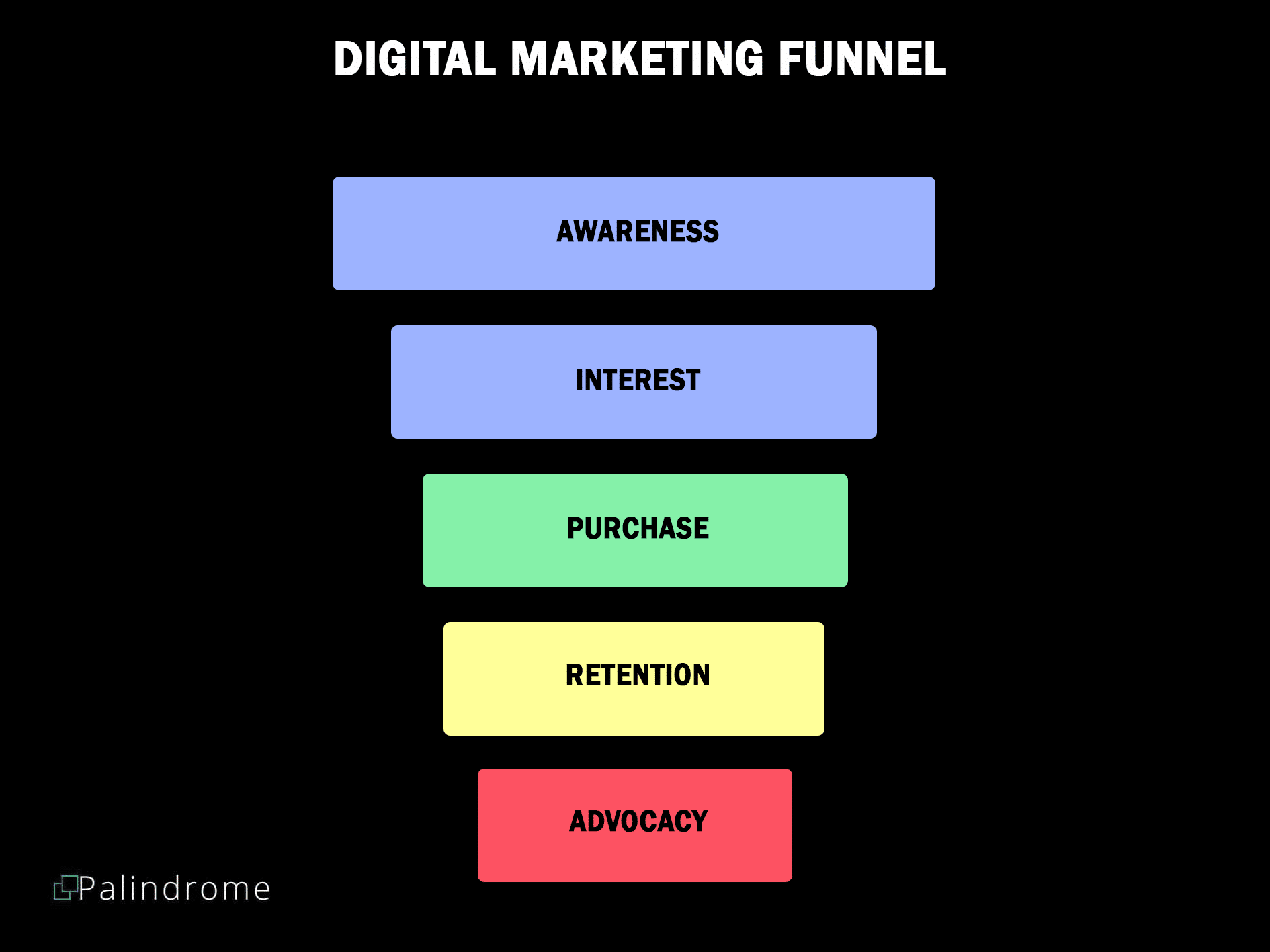
In general, marketing funnels are structured with top, middle and bottom sections. At the top, awareness is used to generate reaching power and acquire fairly cold prospects. From there, potential prospects are led further through the funnel to the interest phase, where they are considering your offer. Next, the conversion phase involves warm prospects turning into purchasing customers who have opted for your products or services. At the bottom of the funnel, retention phases can include turning customers into loyal fans who keep coming back. Finally, brand advocacy is the ultimate win for any marketing strategy, where loyal fans become avid lovers of your business and willingly promote your brand’s offerings to their personal networks.
Marketing funnels and digital marketing funnels are somewhat similar in structure and hierarchy. However, what distinguishes digital funnels is the range of approaches, methods, tools and tactics used to accomplish each of these vital steps. Clearly, the ways of which you acquire more business are based on more digital components.
Is a marketing funnel and a sales funnel the same thing?
For the most part, both of these funnels are heavily associated with each other, but there is a subtle difference. Many people get mixed up about the two concepts. Think of it as a two-step process. The marketing funnel deals with the initial process of enticing interest or giving leads a reason to buy into the offer. From there, the sales funnel takes over – dealing with the leads that trickle down from the marketing process. The job of sales is to close the deal and get them to buy, again and again, thus increasing customer retention rates.
With that, let’s delve into the specifics of the phases comprising digital marketing funnels.
Awareness
Digital marketing funnels rely on the awareness process for reeling in curious bystanders before turning a portion of them into raving fans. What makes an awareness campaign? Well, the slew of prominent social media channels for one, as well as active PR campaigns and advertising initiatives that rely on educating the market are all effective options.
As a brand owner, your job is to establish a presence in online spaces that act as congregation points for potential prospects. Whether this means Facebook, Instagram or Youtube, or whether they exist in less prominent silos such as niche forums or Reddit sub-groups, you’ll need to infiltrate these platforms and find your tribes.
Interest
So now you’ve got their attention, it’s time to satisfy their curiosity. The consideration or interest phase brings you one step closer to the purchasing process, which means intensifying initial procedures and providing more information, details or even value upfront to prospects.
Run more ads – possibly targeted campaigns which focus on groups that have visited your website or engaged with your previous touch points. You’ll need to convince them, so to speak, of the numerous advantages or features that your offer has in store for them. Think about the possible inquiries or questions that they have, assuming that they are already interested.
This is also where content marketing and SEO (Search Engine Optimization) come in strong, normally sitting between the awareness and consideration phases of digital marketing funnels. Content in the form of guides, tips, comparisons or breakdowns can help with the discovery process of your marketing tactic – which sends prospects through a loop that either allows them to understand more about your business or provides value to them in some shape or form, elevating your brand equity in the process.
Don’t forget about your CTA (Call-To-Action) which should be visible in as many content pieces and site pages as possible to let visitors know about your offer.
Purchase
Now the prospect is aware, interested, and ready to buy. The purchasing phase is crucial and there are a few variables to take note of. Firstly, your website and purchasing channels have to be in tip-top shape. Site speed must be optimized, UX (user experience) must offer a seamless buying process and the pages must be painless to navigate through. Offer as many conveniences as possible along the way. Make it easy to fill in details, offer as many payment options as you can, and consider all the other hiccups that can occur towards the purchase point.
Use tools like heatmaps on your site to see where visitors are having the most difficulty or spending the most time. This can help iron out any troublesome elements throughout your site. In 2021 and beyond, the buyer’s process will continue to grow more crucial, so it’s worth noting that you refine your purchase phase as best as you can to stay ahead of your competitors.
Retention
This is where the role of sales comes into full force. The idea here is to nurture recurring customers. Don’t forget about the first-time buyers, keep in touch with them now that you have their details. Touch base with them through email marketing, keep adding value with informative content or customer discounts and deals that keep them coming back. Loyalty programs play a big role in retention, so be sure to set them up before hand.
Customer service is also an integral part of this process. The more responsive and helpful your team is at getting back to questions, complaints or inquiries, the stronger your brand grows inside the mind of the consumer.
Advocacy
If you’ve done everything right, the advocacy phase will play out on its own in a natural way. When your offer is exceptional, your service is on-point and your marketing tactics are sharper than a steel blade, then customers can’t help but to glorify your efforts.
What can be done along the way, is that you give a gentle nudge to buyers and suggestively encourage advocacy. Circulate surveys related to customer satisfaction, remind them to share your business with their network, and maybe even incentivize advocacy with referrals or affiliate programs.
Bonus tips for reinforcing your digital marketing strategy
Develop an SEO strategy
With search engine optimization, the marketing strategy works hand in hand to push your brand’s awareness efforts forward. Most businesses rely on Google AdWords for ads, which can be very pricy, but SEO is a great choice because you don’t have to pay for each search engine click you get. Social media marketing plans usually rely on a combination of organic and paid campaigns, and platforms may have their own conditions for SEO.
An effective SEO strategy needs to define a specific keyword that will draw high traffic to your low-competitive startup website and modify your site to use those keywords to improve your search results positions.
• Make structural and code-changes to your site.
• Add keywords in your Title Tags.
• Publish consistently high-quality content and create new landing pages to target new queries.
• Add in internal links between related pages.
• Attract high-quality backlinks to your domain.
This is a lot of work, but the effort is worth it as your startup will reap tremendous long-term benefits, as SEO could account for up to 50% of your monthly overtime traffic.
Build a referral network
The easiest way to advertise for startups is to build a campaign that encourages your customers to advertise for you. New customers are likely to buy your product or service when referred to your company by a past client – their friends, family, and workmates. More than anything, individual confidence, personal advice, and the growth of social networks and strategies for social sales play a major role as part and parcel of your social media marketing plan. Create a referral program that enables your customer to get gifts or give a discount to your current customer in return for a new customer referral.
Transparency, particularly for start-ups, is a very important quality, even if nothing goes wrong. Asking for feedback is a perfect way to consider your customers’ personalities and how happy they are with your company’s service so that you can draw on this for the future.
Cultivate relationships with influencers
Like your clients, influencers are just as essential. They are the people that the target audience listens to regularly. Influencers may include YouTube channel hosts or TV and radio celebrities. An effective social media marketing plan often includes an outreach aspect towards influencers who are a suitable match for the brand.
Call possible influencers, send emails, provide goods or services free of charge. One mention from these high-profile individuals will catapult your business start-up to a credible and legitimate force from practically nothing.
Launch a content marketing strategy
There are many different strategies for content marketing, and none of them needs to be costly. Starting a blog or a guide and introducing in some special and realistic way new, insightful, or entertaining material, such as answering questions your customers may have, is a great way to grow your audience. To further engage your guests, you should complement your campaign with infographics, podcasts, and videos. The correct inbound and content marketing strategy will enhance the credibility of your company, increase your traffic and complement another strategy in this article’s form.
Build a social media marketing plan
The power of an inexpensive social media marketing plan is recognized by many startups. However, only a few understand the significance of using the right platforms. Different personalities and audiences serve different social media sites. Audiences interact differently with each platform. Thus, it’s up to you to decide what works best for your business.
Some of the channels and their behaviors include:
• Facebook: This is the powerhouse of social media. You’ll likely find all audience types on this platform. But you are not in business for everyone, so you must determine where you can find your targets and reach out to them.
• Instagram: This is a great tool for native advertisement purposes. Since the algorithm is optimized for valuable content, you’ll likely gain a natural following of your target audience if you provide quality content.
• Twitter: Twitter is another top-notch social media channel that can enhance a social media marketing plan. However, consistency is paramount to gain and maintain a significant audience. The ultimate goal should be to provide content that is relevant to your audience.
It’s recommended that you analyze each channel and test it. You can participate in a funded campaign for a small amount of money. With due diligence, you can be assured you can produce success sooner rather than later.
Video Marketing
Short, interactive, and insightful videos are the real deal now. Posting videos that align deeply with the goals and vision of your brand helps your clients to understand what you stand for. This is why brands are now increasingly sharing videos to update their audience and spread awareness through social media tools like Facebook Live, Instagram Stories, and Snapchat stories.
Additionally, for your audience, you could also post engaging tutorials, webinars, and live Q&A sessions. This will not only help to keep your audience involved, but also answer your product/service questions.
Focus on User Experience
Your audience is all about you, as the marketing emphasis has changed from profit maximization to maximizing customer loyalty. Keeping them happy and fulfilled will ensure that you remain important for the long haul in the market. Therefore, it is important to plan all your digital marketing strategies, keeping your target audience’s desires, requirements, and pain points in mind.
You need to spend your time and money on research to do this. Figure out what kind of content your audience is will interact with the most, what products/services will better solve their concerns, what social media platforms do they spend most of their time on when they are online, what they say on social media channels about your brand and products/services, and so on. This kind of thorough study would help you better understand your audience and help you develop a special and personalized user experience for them. In fact, many social media marketing plans and marketing plans, in general, are now designed to closely correlate with good user experience.
Know your competition
Chances are that your rivals are also using social media, and that means that you can benefit from what they do. A competitive evaluation helps you to consider who the competition is and what they are doing well (and not well). You will get a clear idea of what is expected in your market, which will help you set your own social media goals. It will help you spot possibilities as well.
For instance, maybe one of your rivals is dominant on Facebook but has put little effort into Twitter or Instagram. Instead of trying to attract viewers away from a dominant player, you might want to concentrate on the networks where your audience is underserved.